
In this next feature in our series analysing an exclusive Field Service News Research project run in partnership with Salesforce we now turn to ask what might we be sacrificing if we move to firmly into a world of remote-first as a default?
While there are undoubted benefits, as we’ve outlined in the previous section of this report, to a remote-first approach to service delivery, we must also consider the downside of such an approach if we are to reasonably establish if this is the right way for our sector to evolve.
For many years we have focused on the significant benefits of the close interactions a field service engineer or technician will have directly with the customer when visiting their site. We have extolled the virtue of the engineer as the brand ambassador and highlighted the importance of the engineer being a subject matter expert as critical factors in the success of establishing a strong brand reputation for delivering service excellence.
Indeed, previous studies by Field Service News Research have shown this to be the case. In one recent study, we established that 55% of field service companies see the primary function of the field service engineer being an expert onsite, with a further 27% seeing the primary role of the engineer being a brand ambassador. That same study also revealed that almost half (48%) of field service companies believe that their customers will still perceive a greater value in a face to face service call than remote service delivery. In comparison, only 13% of companies felt their customers would see greater value in remote services over face to face service delivery.
So, are we at risk of sacrificing this important, trusted advisor status if we move wholeheartedly into a world of remote-first service delivery?
The findings of this study would seem to suggest that the pervasive thinking is that this could well be the case. We asked our respondents if they felt there are more potential benefits for their business if their engineer was able to access the customer’s site in person and leverage their trusted advisor status. The overwhelming majority of companies (90%) stated that they believed this to be the case.
But let us take a closer examination of why these companies believe this to be so and explore precisely what it is that field service companies may be sacrificing if they were to move towards a remote-service-as-a-default approach to service delivery. (figure 7).
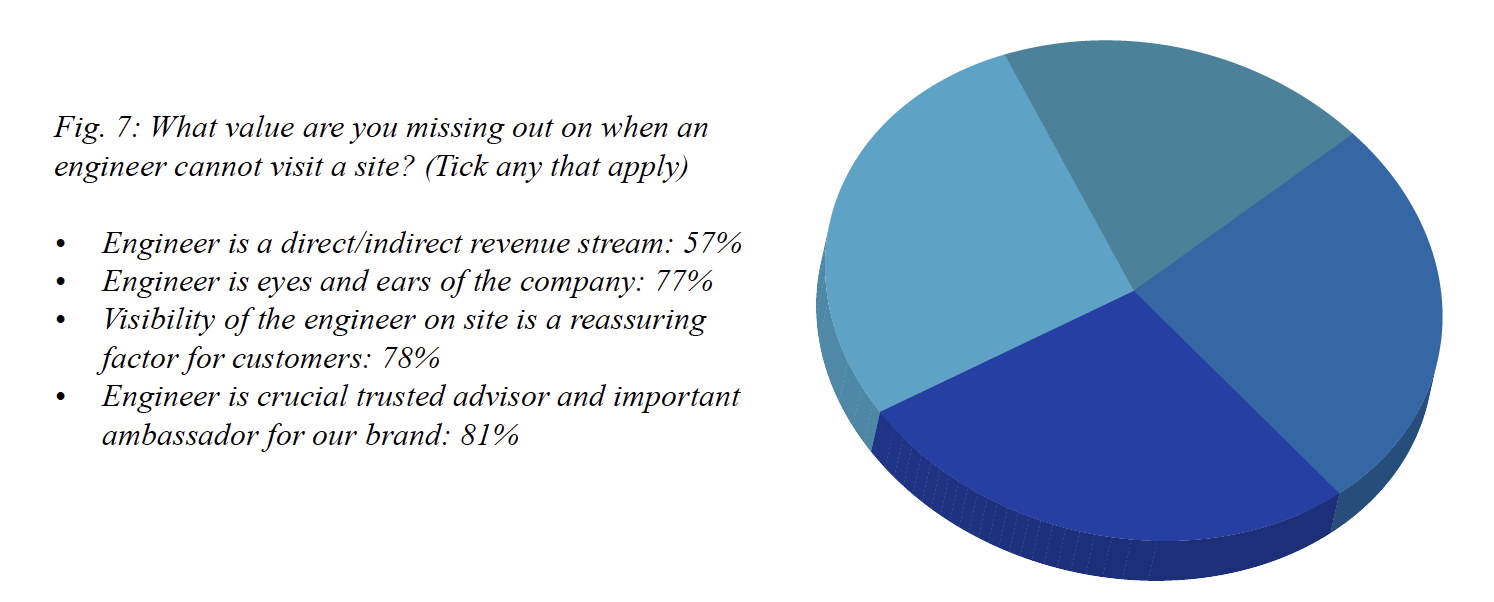
As alluded to above, the greatest fear is the loss of the trusted advisor status. This reason was cited by over three quarters (81%) of respondents. The point also correlates closely with the visibility of the engineer onsite being a reassuring factor for customers, which was also cited by over three quarters (78%) of respondents. Indeed, this echoes conversations held in the industry for some time around the shift from reactive to preventative or proactive maintenance.
One of the issues within that transition that has often been raised is the loss of ‘theatre’ when a field service engineer arrives onsite and resolves a critical problem quickly, efficiently and in a professional manner. Of course, as this shift from break-fix to preventative service has become more commonplace, that issue has mostly become negated. The savvy field service organisation is sending their engineers armed with the tools and data available to demonstrate the value they are bringing to their customers, on each site visit, in a more measured approach. The ‘theatre’ of break-fix is perhaps lessened, but the message of reassurance magnified.
The question we must now acknowledge is, will the customer still make time for the engineer or technician to deliver that message in the less personal mechanisms that remote service delivery utilise? The case can, of course, be made in both directions. One suggestion outlined by Gary Brandeleer, Senior Director of Product Marketing, Salesforce Field Service, on a recent episode of the Field Service Podcast, is that the trusted ambassador status could potentially be moved from just one single point of contact (the engineer or technician) to the broader organisation.
“Suddenly instead of having just one single person as the face of your company, you might have an easier way to present multiple persons in front of the customer…”
Gary Brandeleer, Salesforce
As Brandeleer explained “We may lose out in some instances in having the trusted advisor onsite, but at the same time it does create better customer relations with the back office. Before, the only face of the company was often the technician – now the customer has the faces of many people that are working in the office and helping them to find answers to their problem here on site.
“Where that’s really a benefit is that suddenly instead of having just one single person as the face of your company, you might have an easier way to present multiple persons in front of the customer.”
This is certainly a valid observation and could well be the way service organisations evolve to expand their contact points with their customers, deepening the customer relationship further while simultaneously making it less reliant on specific individuals. It is also very much in line with the broader industry thinking around the importance of establishing a more holistic 360-degree view of the customer.
Another area that is a concern when we consider how the value of the service engineer or technician could be diminished by the adoption of a remote-first approach to service delivery, is the important role the fieldworker plays in identifying revenue opportunities from the field. Again, this is noted by a significant portion of field service companies within the study, with over three-quarters (77%) stating that their engineers are the eyes and ears of the company and this is a value they would be missing out on if the engineer cannot visit a site. Further to this, well over half of the respondents (57%) state that their engineers and technicians are a direct or indirect stream of revenue.
As with most two-sided problems, the solution will invariably remain somewhere in the middle. There is already much talk of hybrid models, including on the pages of www.fieldservicenews.com which see an evolution of the service contract, blending the best aspects of digital and the physical service delivery.
One such hybrid model that seems to be gaining initial traction in theory at least, is a model that sees remote-service as the mechanism for regular maintenance and repair, taking advantage of the speed and reduced costs. At the same time, the onsite visit becomes more centred around consultancy and offering the customer the opportunity to have a subject matter expert to hand not only to ensure everything is as it should be but also provide advice on how best to optimise their assets.
Such an approach would also appear to be in line with field service companies believing their customers see the value of the service engineer or technician onsite (figure 8).
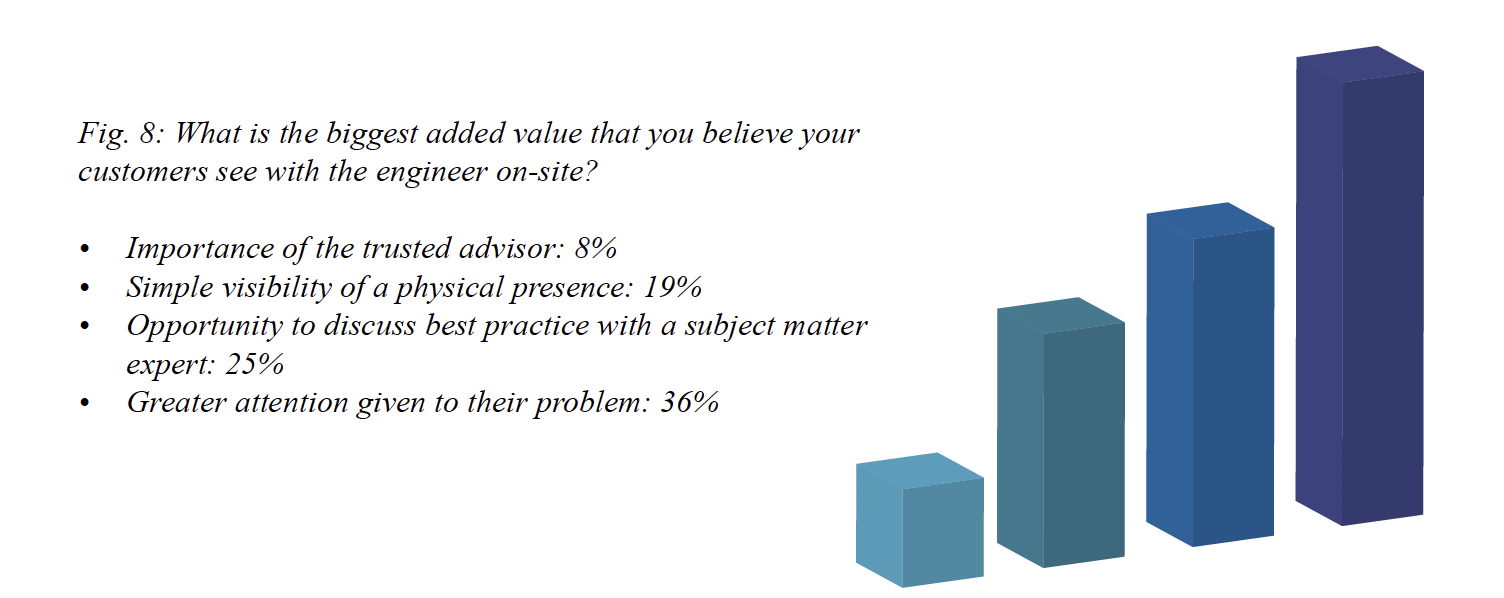
We asked the respondents of the study to identify the single most important added value that they felt the customers see from having a service engineer on site. The most commonly cited responses were both ‘greater attention given to their problem’ (36%) and the opportunity to ‘discuss best-practice with a subject matter expert’ (25%).
The fact that these two responses scored so highly and accounted for nearly two-thirds of all responses would appear to be a strong indicator of the value that lies in the engineer, as a subject matter expert, giving customers one to one attention in person.
 Want to know more? The full paper is available in the premium content library.