
• About
  • Advertise
  • Contact Us
  • Privacy & Policy
  • Login
Webinar: Why B2B Buyers Stop Clicking and Start Calling
  • Home
  • News
    • Aftermarket
    • AI
    • Asset Management
    • Digital Transformation
    • eCommerce
    • Field Service
    • Parts
    • Pricing
    • Supply Chain
  • Events
  • Library
  • Library
  • Subscription
  • Subscribe
No Result
View All Result
  • Home
  • News
    • Aftermarket
    • AI
    • Asset Management
    • Digital Transformation
    • eCommerce
    • Field Service
    • Parts
    • Pricing
    • Supply Chain
  • Events
  • Library
  • Library
  • Subscription
  • Subscribe
No Result
View All Result
No Result
View All Result
Home Feature

Understanding the Value of the Field Service Engineer

Norgren Selects Syncron for Pricing Intelligence Driven by AI/ML for Greater Profitability

In the last feature in this series reflecting on the findings of an exclusive Field Service News Research project run in partnership with FieldAware, we looked at whether the pandemic had impacted field service organisations relationships with their engineers, now we look at where these organisations see the value of the service engineer…

It is clear within the study, that the field service engineer and technician is not only highly valued within most field service organisations, but they are also well connected to and able to easily communicate with both peers and management alike. So, having established that value, lets us take a moment to dig deeper and break down what that value is founded upon.

In the light of such findings we can also take a look at how central the engineer is to the technology ecosystem. One of the hall marks of the best-in-class field service management systems is the ability to deliver knowledge and expertise to the engineers when they need it most.

We took a moment during the study to understand how field service organisations are managing this task.

The largest segment of the companies in the study, which accounted for nearly half (48%) of field service companies utilise peer-to-peer coaching to achieve this. The second most commonly cited method was via an online knowledge base which over a quarter (27%) of companies utilise while just under a fifth deliver knowledge to their engineers via a mobile application. Only 4% of field service companies are still providing their engineers with onsite manuals.
Screenshot 2020-10-15 at 21.05.31

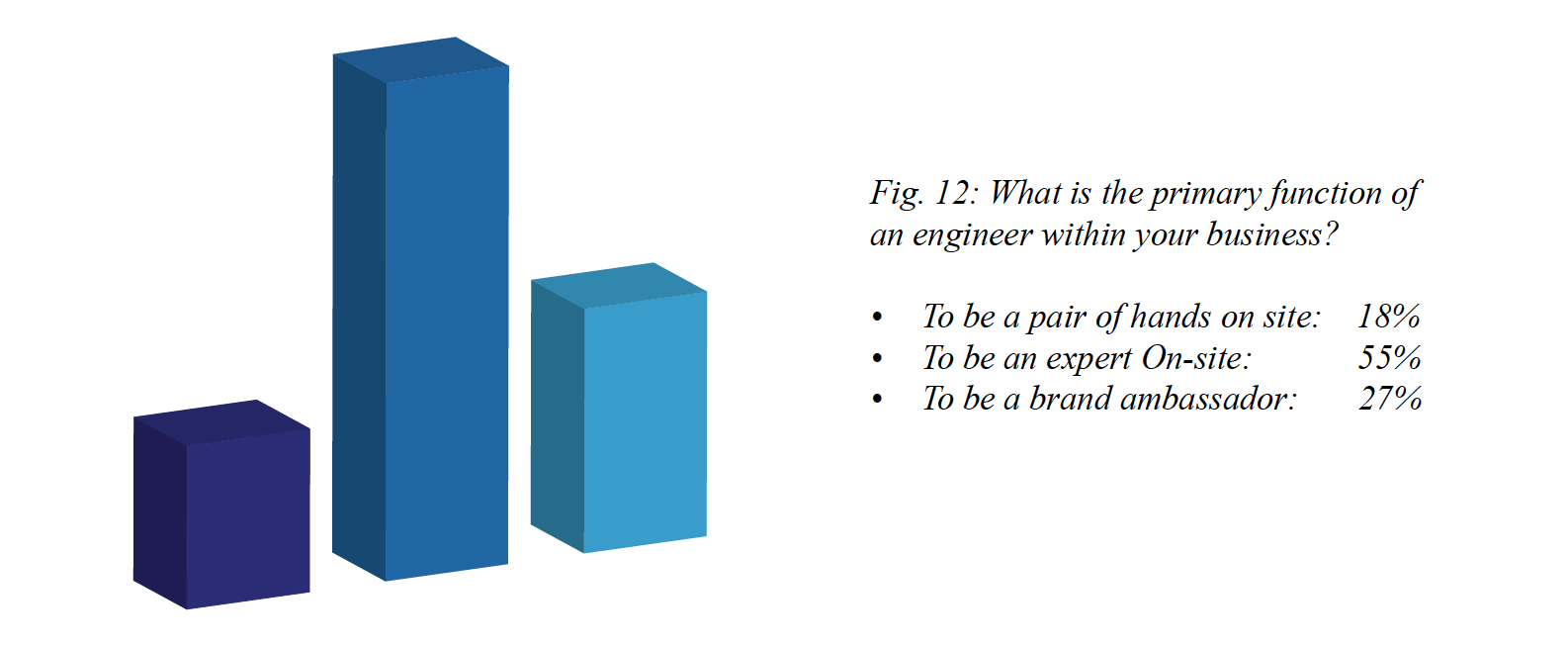
We asked the respondents in the study what was the primary function of the field service engineer or technician within their respective businesses? For over half (55%) of companies the primary function of the engineer is to ‘be able to trouble shoot problems and identify resolution that couldn’t be found through initial triage i.e. to be an expert onsite’.

For almost a third (27%) of companies the primary function of the engineer is ‘to interact with the customer in a professional manner and identify additional service revenue opportunities i.e. to be an ambassador onsite’. The smallest response group here which was just under a fifth of companies (18%) stated that for them the primary role of the engineer was to ‘implement a fix based on fault analysis that leverages machine data and remote expert interaction – i.e. to be a pair of hands on site’. (Figure 12 above)

This set of findings within the study are strongly juxtaposed with earlier findings relating to the rapid adoption of tools that provide the service provider with the capability to deliver remote service offerings, as well as the findings that the majority of service organisations see remote service delivery as a new revenue stream.

It is clear from the responses to this particular question that the large majority of field service organisations see far more value in the service engineer than being a physical asset ‘a pair of hands on site’. In a world of remote-first service delivery that many are predicting, this would appear a significant part of the engineer and technicians’ value being sacrificed?

Once again we appear to be building a case for the emergence of a hybrid model of service delivery that finds the balance between the rapid effectiveness of remote-service delivery and the deeper value of the field service visit bringing the expert knowledge and insight directly to the customer on site.


Screenshot 2020-10-14 at 13.39.48Want to know more?

You will find the full paper in the premium resource library.

Webinar: Why B2B Buyers Stop Clicking and Start Calling Webinar: Why B2B Buyers Stop Clicking and Start Calling Webinar: Why B2B Buyers Stop Clicking and Start Calling
Previous Post

Research – We Need to Give Far More Consideration to How We Incorporate Remote Services into Service Revenue Models

Next Post

Brave New World: Digitalisation and Servitization

Next Post
edit post
How Companies Can Achieve Successful Service Delivery in the New Normal

What Are The Core Fundamentals of Great Service?

Stay Connected

  • 23.9k Followers
  • 99 Subscribers

Stay Connected

  • LinkedIn
  • Newsletter
  • Trending
  • Latest
edit post
The Challenges of Globalization and Centralization

From Data Overload to Actionable Intelligence: Making CRM Work for the Modern Enterprise

October 16, 2025
edit post
Keeping Cancer Treatment Systems Treating

Spare Parts After Hours 24: Thibaut Van den Berghe, Katoen Natie

July 4, 2024
edit post
The Big Discussion: Artificial Intelligence and Field Service (part three)

Field Service Forum After Hours 24: Aymen Gatri, Aftermarket and Service Expert

August 15, 2024
edit post
White Paper: Modular Construction Meets FSM: A Strategic Blueprint for Enhanced Efficiency and Innovation (2024)

White Paper: Modular Construction Meets FSM: A Strategic Blueprint for Enhanced Efficiency and Innovation (2024)

September 23, 2024
edit post
Field Service Benchmarking driving performance

Making Servitization Happen: Building the Value Proposition

December 5, 2025
edit post
Why the employee experience must be factored into modern FSM thinking

Making Service Visible, Making It Count 

November 6, 2025
edit post
The Challenges of Globalization and Centralization

From Data Overload to Actionable Intelligence: Making CRM Work for the Modern Enterprise

October 16, 2025
edit post
Ecosystem to Deliver Services

Breaking CRM Silos: How Enterprise-Wide Intelligence Drives Growth

October 13, 2025

Recent News

edit post
Field Service Benchmarking driving performance

Making Servitization Happen: Building the Value Proposition

December 5, 2025
edit post
Why the employee experience must be factored into modern FSM thinking

Making Service Visible, Making It Count 

November 6, 2025
edit post
The Challenges of Globalization and Centralization

From Data Overload to Actionable Intelligence: Making CRM Work for the Modern Enterprise

October 16, 2025
edit post
Ecosystem to Deliver Services

Breaking CRM Silos: How Enterprise-Wide Intelligence Drives Growth

October 13, 2025

Brought to you by

Fieldservicenews

Turning knowledge into action for the manufacturing industry.

Follow Us

Browse by Category

  • Aftermarket
  • AI
  • Asset Management
  • Digital Transformation
  • eCommerce
  • Field Service
  • Parts
  • Pricing
  • Supply Chain

Newsletter

Subscribe to our mailing list to receive news and updates direct to your inbox!

Sign Up
  • About
  • Advertise
  • Privacy & Policy
  • Contact Us

© 2026 Field Service News by Copperberg AB | All rights reserved

Ok

Retrieve your password

Please enter your username or email address to reset your password.

Log In

Add New Playlist

No Result
View All Result
  • Home
  • News
    • Aftermarket
    • AI
    • Asset Management
    • Digital Transformation
    • eCommerce
    • Field Service
    • Parts
    • Pricing
    • Supply Chain
  • Events
  • Library
  • Library
  • Subscription
  • Subscribe

© 2026 Field Service News by Copperberg AB | All rights reserved

Insert/edit link

Enter the destination URL

Or link to existing content

    No search term specified. Showing recent items. Search or use up and down arrow keys to select an item.