
At the start of the most turbulent shopping season of the year, taking a look at service departments around the world gives an idea of what awaits customers who are in search of bargains and gifts.
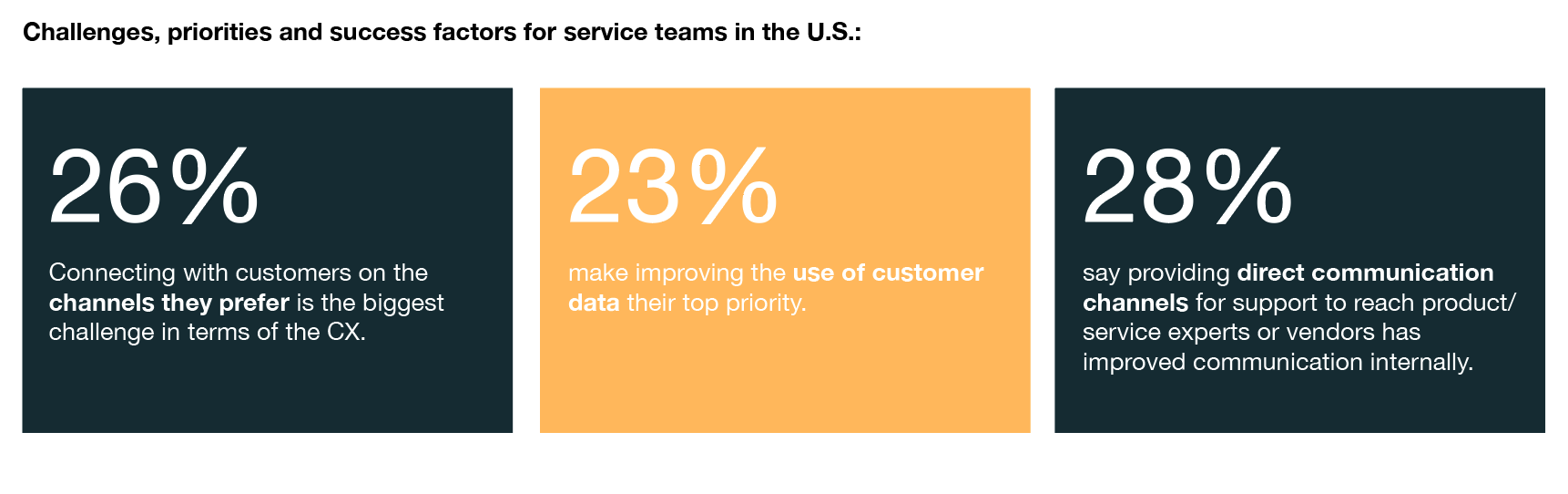
Just over a quarter of customer service executives in the U.S. (26 percent) identify connecting with customers on the channels they prefer as the biggest problem in terms of the customer experience (CX) – long response times could, therefore, be commonplace in many places this year again. However, executives are not standing idly by; they are focusing on other areas to improve. At 23 percent, improving the use of customer data is the most frequently identified top priority of customer service leadership in the United States.
These are the findings of the current “OTRS Spotlight: Customer Service” study, for which the software company OTRS Group, in collaboration with market research company Pollfish, surveyed 500 customer service executives in the U.S., Germany, Brazil, Mexico and Singapore.
Process optimization for better support
The focus on process optimization is critical. More than a quarter of respondents in the U.S. say that having defined processes for escalating problems (35 percent; 33 percent globally) and for contact between sales staff and buyers (24 percent; 20 percent globally) have helped their teams offer customers better support. In addition, in the U.S., providing direct communication channels for support teams to reach product/service experts or vendors is rated by more than a quarter (28 percent) as the most helpful measure for improving communication with other internal departments.
“These days, the customer experience is not only a matter of providing great customer support.” says John Coggins, Director of Global Business Relationship Management at OTRS Group, “Rather, it’s about breaking down internal silos and establishing cross-departmental processes and workflows that add value and facilitate solutions for customers in the most expedient way possible.”
In addition to automating internal processes (25 percent), customer service leaders in the U.S. shared options that are successful in helping teams break through silos, such as having shared metrics between the sales, marketing and support teams (19 percent); having management support for cross-functional customer experience work (17 percent); and the use of a shared ticketing or help desk system (11 percent) is particularly helpful for teams to improve this crucial communication between agents and other internal departments.
Complete customer data and cross-departmental communication required
The need to connect different departments for the benefit of the CX is also reflected in the need to rely more on data these days. Respondents in the U.S. identify this as particularly helpful for their customer service teams. Providing agents with context-based help information during customer interactions (44 percent) and giving them access to complete customer data (43 percent) top the list.
Apart from this, a quarter of U.S. executives (27 percent) rate having product/service experts provide in-person training as the most successful measure for improving their agents’ understanding of the company’s products and services: other options included the use of webinars (20 percent ) and documentation or internal FAQs (17.5 percent).
While executives have recognized what they need to do to improve their CX, they still encounter obstacles when it comes to implementation. After connecting with customers on the channels they prefer (26 percent), their biggest problems are staff shortages (22 percent) and aligning internal teams around the customer journey (17 percent). 14 percent struggle primarily with connecting data from multiple systems; 12 percent with a lack of training or understanding of upselling opportunities; and nine percent with failure to follow up to queries in a timely and appropriate manner.
IT-supported service departments are top priority
 Many are looking to technological solutions for support in overcoming all these challenges. Just under half of U.S. customer service executives (44 percent) currently give these top priority in various forms: For 19 percent, improving the company’s use of newly deployed technical solutions is most important; 15 percent prioritize the implementation of modern service desk technology solutions; and 10 percent will focus primarily on deploying human-centered technology, such as video chat, in contact centers. For 17 percent, improving agent satisfaction is the top priority.
“In customer service, it’s all about finding the right balance for the interplay between people and technology,” says Andreas Bender, VP Global Consulting at OTRS Group. “Although it is important to support and automate both internal and external processes across departments with IT solutions, managers should not underestimate the value of happy employees for customer satisfaction. Those who pay sufficient attention to and balance both technology and people will ultimately have the greatest business success.”
*The data used is based on an online survey conducted by Pollfish Inc. among 500 customer service leaders in Germany, USA, Brazil, Mexico and Singapore between 22/07 and 06/08/2022. More results of the survey can be found here.